1 / 5
- Ten minutes a day
- 30 Bible references
- A 150-word letter
- 50 printable pages
30-day scripture journal · Guide + workbook
Where did grace show up today?
Thirty mornings, each with a Bible reference and about ten minutes on the page. One thing you can point to finishes the entry. So does the line 'not yet'.
- Thirty day pages, each with its own reference and a paraphrase written for this journal
- Five moves on the steps page, minutes beside each one, and a stop at about ten minutes
- Four weekly readings, each with a different question, plus a checklist for missed days
- A lined letter under 150 words, with keeping allowed when contact would be unwise
Rooted in Grace: A Scripture-Anchored Gratitude Journal
£7
- +One combined book PDF (guide and workbook in a single file)
- +Instant download: PDF files you can print or use on a tablet
One-off payment. Download straight after checkout.
30-day refund. If it isn't useful, reply to your receipt within 30 days for a full refund.
Instant PDF Print or tablet Any device
What it is+
A 30-day gratitude journal. The question on every day is where grace showed up. Grace, here, means a specific mercy you did not engineer. Plan on about ten minutes, then stop.
What's inside+
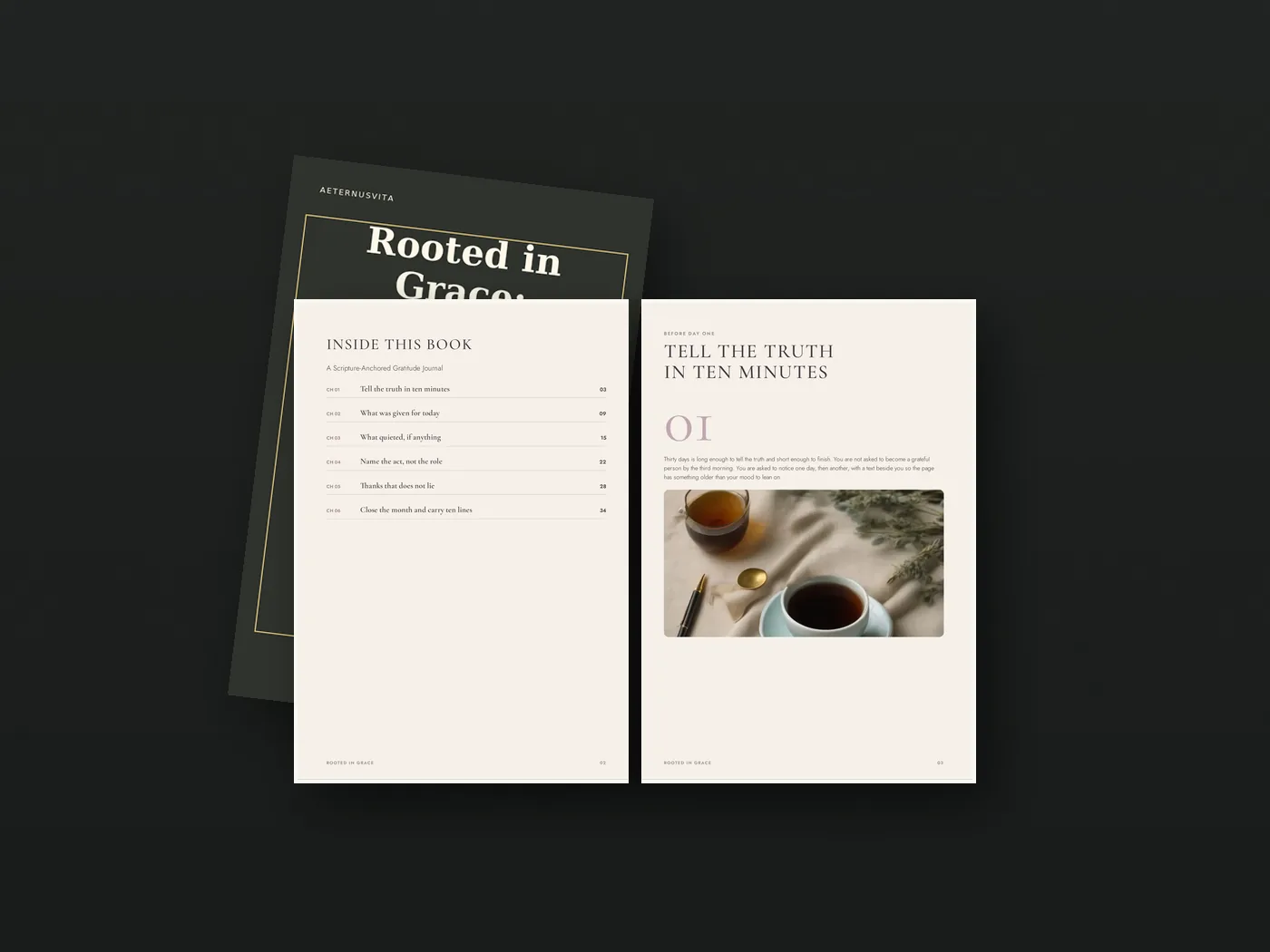
Six chapters and thirty prompted days. Each of the four weeks ends on its own reading. A ten-row prayer record sits apart from the thanks. A letter page and ten memory lines are included. The guide has a copy-forward master for mornings after day 30. The workbook PDF is a daily page you can copy for days 1 to 30.
How to use it+
Before day one, name where the journal lives and which three dates you may skip. Each morning, follow the five moves on the steps page. After each week, complete that week's reading. On day 30, read the month back and decide whether to continue or to rest until a date you write down.
Delivery and refunds+
Instant PDF download after payment. The ZIP holds the guide, the workbook, a README and a licence. Refunds follow the policy shown at checkout.
Made for the morning a cheerful list would be a lie

You write the same three words
Family, health, home. By the second week a category has taught you nothing. The prompt asks for a deed you could point to, and for the time of day it happened.

Cheerfulness would be a lie
An unpaid bill stays unpaid on the page. Where grief or illness is in the house, you may leave the lines empty and write only to the loss. The journal will not ask you for an upside.

You want the verse in your own Bible
Every day names a real reference and a short paraphrase written for this journal. Day 1 is Psalm 23:1 and day 30 is Psalm 136:1. Read the passage in the translation you trust, and follow your Bible where the wording differs.
The problem
A category teaches you nothing by week two
The same categories come back, and by the second week they teach you nothing. A flat morning brings guilt. The paraphrase does not require a mood. Miss a few days and it is tempting to invent thanks you cannot remember. Chapter 1 shows what to write instead. It names six ways the page goes wrong.


How it works
Ten minutes, five moves, then stop
Sit in the place you named for the journal. Read the day's paraphrase, and the reference in your own Bible when it is in reach. Write what you can point to. One line is enough, and if the page is bare, say why. Answer where grace showed up with one scene, or with 'not yet'. Yesterday's scene stays on yesterday's page. Close with one sentence of prayer. The minutes beside those five moves add up to about ten.
This journal vs a generic gratitude list
Why the question is where grace showed up
Grace, in these pages, means a specific mercy you did not engineer. Chapter 1 includes an invented Tuesday so you can see the grain of a finished page. Someone at the surgery held the door. Soup from Sunday was eaten at half past six, and a sister sent two words to say she was home safe. The bill in that sample stays unpaid, and the page does not call it a blessing.
Each paraphrase is original wording for this journal, set beside a real reference so you can check it. No published translation is quoted. You read the passage in the translation you trust. If the paraphrase and your Bible differ, follow your Bible.
The prompts change as the month turns. You begin with provision at the size of a day. The peace week asks what quieted while the trouble stayed. The people week asks for one particular act. From day 22, a sentence has to sit beside the pain at full size, or it stays off the page. The last two days ask which line you will carry, and whom you will thank.

The daily order01
Ten minutes, then close the book
Allow about a minute to sit and about a minute to read. The writing is the longer part, about four minutes for lines you could point to. Leave about two minutes for the grace question and about two for one sentence of prayer. Then you stop. Away from home, a shorter entry is allowed. A tired night still uses this order. If a text would press you to deny a real wound, write 'not this text today'. Use Psalm 34:18, or another passage you can bear.

Days 22 to 2802
Leave the problem at full size
The fourth week is the one people abandon, and the reason is often good. Famous verses get used to shrink pain. The teaching page says what each text offers. Isaiah 41 offers presence and help, with no end date for the threat. On Paul's thorn, grace is called sufficient after he asked three times for it to leave. You can leave the thorn unblessed. If you opened the book and wanted to shut it, write that, and add one fact about the day.

The close03
Read the month as a record
On the last day you read the month as a record of attention. The chapter says not to score it. 'Nothing shifted' is allowed. The letter stays inside one scene, under 150 words. Send it only when the other person could hold that scene safely. Read it aloud if a message would put them on the spot. Keep it when contact is unwise, or when they have died. A kept letter is complete. Hopes sit on a separate record, marked open, changed, answered or released.
As easy as it gets
The morning order, in three steps.
1Step 1
Sit and read
Use the place you named on the opening page. Read the paraphrase once, slowly. If your Bible is in reach, read the reference there and follow it where the words differ.
2Step 2
Write what you can point to
Up to three lines: a person and what they did, an object, or a moment with a time of day. One line finishes the entry. Then one scene for the grace question, or the words 'not yet'.
3Step 3
One sentence, then stop
Close with one sentence of prayer. Shut the book while you still have something left to say. Leftover words are not a failure of devotion.
Timeline
What to expect
Every month reads differently. Here is how the journal is designed to be used.
Name the month you are in
You name the time of day you will open the journal, and the place it will live. For three dates you are likely to skip, you write a two-minute version: one thing you can point to, then stop. The first prompted day is Psalm 23:1.
What's inside
- Chapter 1. The question, a definition of grace, the ten-minute order, an invented sample day, six ways the page goes wrong, and a checklist for missed days
- Chapter 2. Days 1 to 7 on provision, four tests before a line qualifies, and the week-one reading
- Chapter 3. Days 8 to 14 on a quiet that can sit beside an unsolved problem, and the week-two reading
- Chapter 4. Days 15 to 21 on naming an act, a privacy test for thanks said aloud, and the week-three reading
- Chapter 5. Days 22 to 28 on what the harder texts offer and what they refuse, with room to skip a wounding reading
- Chapter 6. Days 29 and 30, a letter in six moves under 150 words, a ten-row prayer record, ten memory lines, a copy-forward master and a reference finder
- A reproducible daily page for days 1 to 30 is included in the book PDF
Preview the pages
Still have questions?
What if I miss a few days?+
Leave the gap visible. Do not fill blank dates with thanks you cannot remember. Name the missed dates in one line, then do only today's reading. If most of a theme has passed, reread that teaching page once and complete the weekly reading with what you remember. If the journal has become a reason to feel small, choose a rest and write the date you will reconsider.
Do I need a printer?+
The ten memory lines are set out to cut out and carry, so a printer helps for the cards. The guide and the workbook are PDFs, and you can read them on a screen.
Is this a substitute for pastoral care or therapy?+
No. It is a devotional and reflective journal. It is not a substitute for pastoral care or mental health care, and it is not medical advice. Nothing in it promises a change of mood, circumstances or faith. If you are in crisis, if you may hurt yourself or someone else, or if you cannot cope through the night, leave the journal. Contact a trusted person and your local emergency services.
Which Bible translation does it quote?+
It does not quote a published translation. Each day has a real reference and a short paraphrase written for this journal. Read the reference in the translation you trust. If the paraphrase and your Bible differ, follow your Bible. From day 31, the copy-forward page asks you to copy one sentence from the translation you use.
What if a passage presses on a real wound?+
Write 'not this text today' and use Psalm 34:18, which is day 24, or another passage you can bear. Come back later only if you want to. The James 1 prompt says you are not asked to feel joy about pain. The book treats skipping a wounding reading as part of telling the truth.
Is the sample Tuesday someone's real diary?+
No. The book says that entry is made up, to show the grain of a finished page. It is not a report of what your month will feel like.
How do I receive it?+
After payment you get an instant download: a ZIP with one combined book PDF, a README and a licence.
Instant PDF download · 50 pages · Print or read on a screen
Educational only. This is a devotional and reflective journal. It is not a substitute for pastoral care or mental health care, and it is not medical advice. Nothing in it promises a change of mood, circumstances or faith. Written with AI assistance, reviewed by AeternusVita.
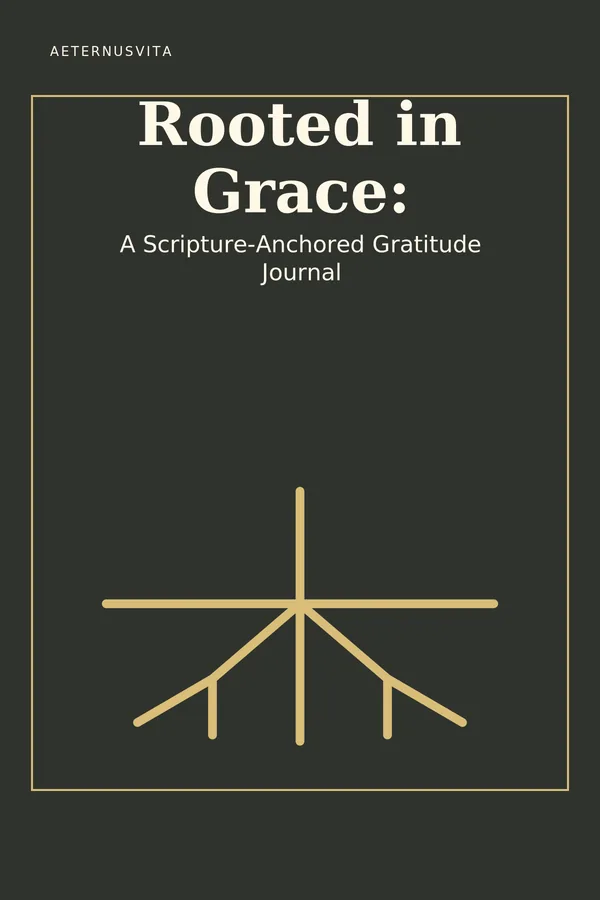
Rooted in Grace: A Scripture-Anchored Gratitude Journal