
2026-10-07 · 4 min read
How a 21-Day Abundance Practice Rewires Your Money Mindset
Most money advice targets behavior: budget this, invest that. Useful — but it skips the layer underneath. Your beliefs about money quietly decide which…
By AeternusVita
We make the products recommended here.
“Most money advice targets behavior: budget this, invest that. Useful — but it skips the layer underneath. Your beliefs about money quietly decide which…”
Most money advice targets behavior: budget this, invest that. Useful — but it skips the layer underneath. Your beliefs about money quietly decide which behaviors you even attempt. A 21-day abundance practice like the 21-Day Abundance Challenge works on that hidden layer. Here is how, day by day, and why the three-week format matters.
Your money story runs on autopilot
Everyone carries a money story: a bundle of sentences absorbed from family, culture, and early experiences. "Money is scarce." "Wanting more is selfish." "I am just bad with finances." You rarely say these aloud, but they steer decisions — whether you negotiate, apply, invest, or quietly opt out before trying.
The challenge opens with a guided mindset audit designed to drag those sentences into daylight. Writing them down is the whole point. A belief you can see is a belief you can question; a belief running in the background just keeps driving.

Repetition is the mechanism, not magic
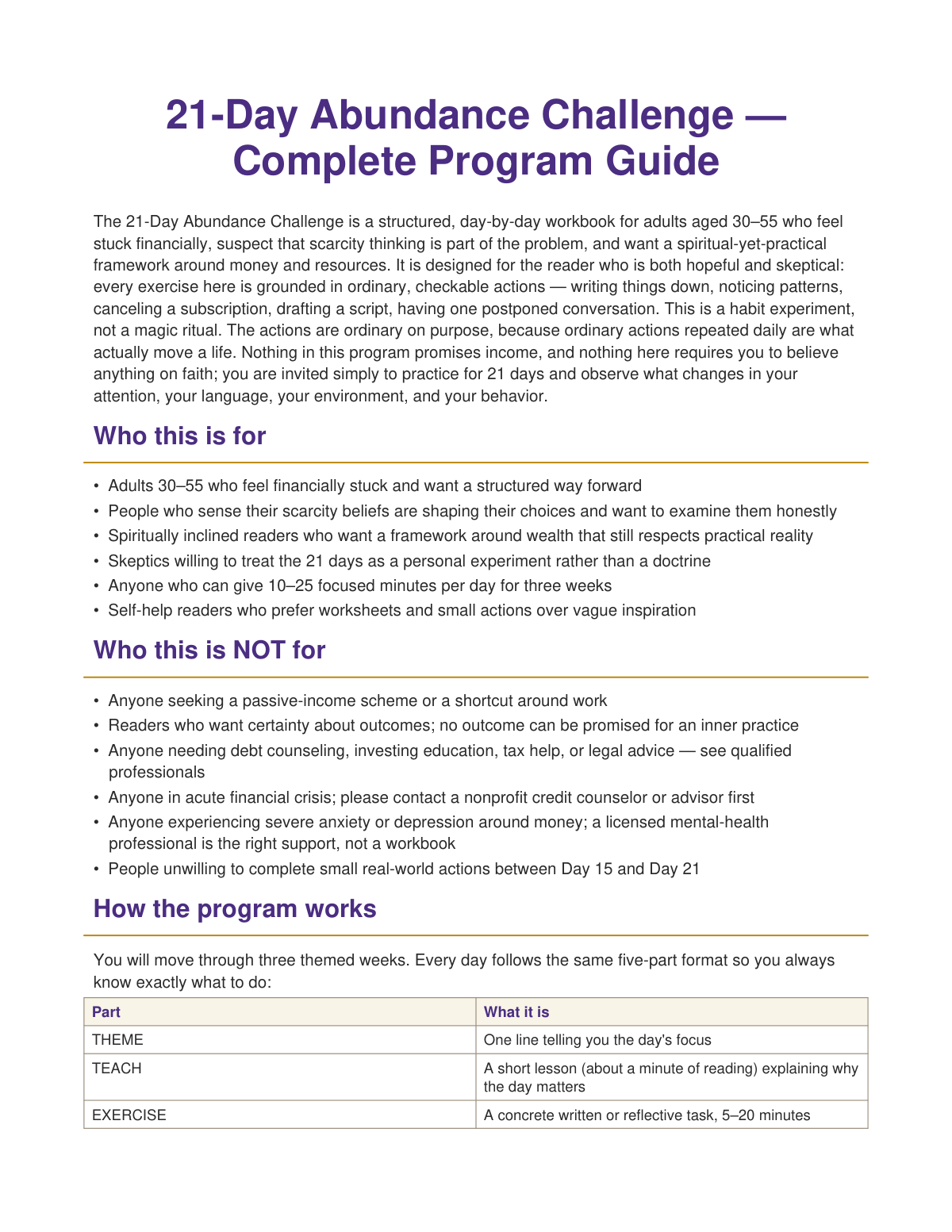
Why 21 days? Because a single insight fades, while a small daily ritual compounds. Each day pairs a morning intention (what you choose to practice today) with an evening check-in (what you noticed). Between them sits one focused exercise: auditing the language you use about money, rewriting a limiting belief in your own words, practicing gratitude, or taking one small real-world action in week three.
Psychologists call this combination self-monitoring plus implementation — noticing patterns and rehearsing alternatives until the new response becomes the default. The challenge adds a spiritual frame (visualization, gratitude, abundance language) that makes the repetition feel meaningful rather than mechanical, which is exactly why people stick with it past day four.
Gratitude and visualization do specific jobs
Two exercises get special emphasis. The daily gratitude line trains attention: when you write down one thing you already have, every single day, your brain practices registering sufficiency instead of only scanning for lack. That shift in attention changes spending impulses and risk tolerance in subtle but real ways.
The Day-13 visualization page does something different. Picturing a desired outcome in concrete detail exposes the gap between where you are and where you claim to want to be — and the discomfort in that gap is motivating. It also surfaces hidden objections ("I could never…") that become the raw material for the belief-rewrite exercises that follow.
Small actions in week three close the loop
Beliefs without behavior are just pleasant thoughts, so the final week shifts toward action: small, concrete steps taken in the real world. Sending the email. Opening the account. Having the conversation. Each action becomes evidence that the rewritten beliefs hold up outside the workbook — and evidence is what makes a new mindset stick after day 21 ends.
One more reason the format works: the challenge is reusable. Beliefs drift back under stress — a bad month can resurrect sentences you thought were gone. Because the workbook is printable, you can redo the full 21 days each quarter, or re-run just week one as a diagnostic whenever you notice old avoidance creeping back. Returning practitioners consistently report that the second round goes faster but cuts deeper, since the audit now catches subtler, better-hidden sentences the first pass missed. Think of it less like a book you finish and more like a dental cleaning for your money mindset: periodic, unglamorous, and quietly responsible for long-term health.
How this book helps
The 21-Day Abundance Challenge (£9, instant digital download) packages this entire arc: the mindset audit, 21 daily guide exercises at 10–20 minutes each, the matching 21-page workbook with morning and evening prompts, daily gratitude lines, the Day-13 visualization page, and a closing reflection to review your three weeks.
To continue the work afterward, the Abundance Alignment Code offers a 30-day alignment calendar plus 40 belief-rewrite prompts for ongoing practice. And because a calm environment supports a calm mind, many readers pair the challenge with The 15-Minute Zone Clean (ADHD Edition) to bring the same daily-ritual energy to their living space.
Related articles
2026-10-08 · 3 min read
How to Do the Morning and Evening Abundance Prompts in 10 Minutes a Day
The number one reason mindset challenges fail is not skepticism — it is friction. A practice that needs 45 unscheduled minutes dies by day three. The…
Read article →2026-10-06 · 4 min read
Should I Buy the 21-Day Abundance Challenge? An Honest Breakdown
If you have ever hovered over a manifestation book, half hopeful and half rolling your eyes, this post is for you. The 21-Day Abundance Challenge…
Read article →2026-10-09 · 4 min read
Abundance Alignment Code Review: Is It Worth $14?
Short answer: if you want a structured way to find and rewrite the beliefs blocking your financial life — with worksheets, not just theory — $14 is…
Read article →