2026-10-25 · 7 min read
Trip Ops: Laser Run: scan your room and run a laser course from pad to pad
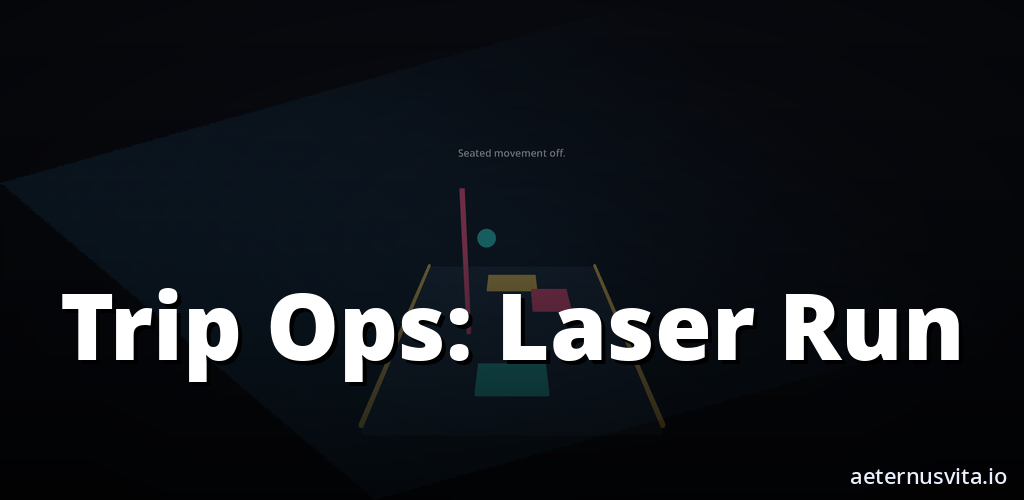
Trip Ops: Laser Run is a mixed reality movement game where you scan your room and run a laser course from pad to pad.
By AeternusVita
“Trip Ops: Laser Run is a mixed reality movement game where you scan your room and run a laser course from pad to pad.”
Trip Ops: Laser Run is a movement game for a VR headset where your room becomes the course. You scan the space, step onto a start pad, and make for an end pad on the opposite wall.
It is coming soon on aeternusvita.io. Visit Trip Ops: Laser Run to get notified when it is ready. This guide explains what it is, how a run works and who it tends to suit, using only the official brief and store copy.
What Trip Ops: Laser Run is
Trip Ops: Laser Run is a movement game played in a headset. The short description says it plainly: scan your room, then run a mixed reality course from pad to pad. The subtitle shortens it further: laser course in your room.
In mixed reality you scan the room and the course scales to that space. A start pad and an end pad sit on opposite walls. The same runs also play in a VR room, for sessions that stay in VR.
You leave the start pad and head for the end. Still beams and sweeping beams cross the space, grids pulse, and drones patrol. Walls move, doors run on a timer, and the floor carries pressure tiles and mines. At the end pad the run is graded on time, touches and style.
It is made by aeternusvita.io. Nothing has been released or submitted to a store, so there are no ratings, reviews, prices or release dates to quote.
How a run works
A run follows a short loop. You scan the room, the course appears between the two pads, and you move from the start to the end.
The room scan builds the course between the start pad and the end pad. The course scales to the space you scanned, so the pattern fits the room you are in.
The pads sit on opposite walls. That gives the course a direction. Between them the obstacles form the route you read and pass through.
You step off the start pad and make for the end. Still beams block a line you must duck under or step around. Sweeping beams ask for timing. Pulsing grids open and close, patrol drones hold a path, moving walls shift the corridor, and timed doors run on a window. The floor holds pressure tiles and mines.
When you reach the end pad the grade appears. It covers time, touches and style. Then the next mission opens.
What you dodge
The brief lists the set as one group: beams, grids, drones, walls, doors and mines. They mix to form different puzzles in each run.
Still beams sit across the space and shape the line you take. Sweeping beams cross on a pattern and ask you to wait for the gap. Grids pulse, so you learn the pulse before you step.
Drones patrol on a route through the course. They add a moving element to watch alongside the fixed beams. Walls that slide change where you can stand and which gap is open. Doors run on a timer: a timed door opens for a window and then closes, so you time your pass.
The floor carries pressure tiles and mines. You keep an eye down as well as ahead.
Because the course scales to the scanned space, these elements are placed to fit your room. The grammar stays the same, but the positions shift to suit the distance between the pads and the size you scanned.
Sixty missions across six settings
Trip Ops: Laser Run is built as sixty short missions across six settings. The settings are a training grid, a data vault, a jungle temple, an ice lab, a neon city and an orbital station.
A mission is a single course from pad to pad. You finish one, see your grade, and move to the next. The collection of sixty is grouped into the six settings, so the look and the obstacle mix change as you progress.
A training grid gives a clean, open read. A data vault and an ice lab frame the course with a more enclosed, technical feel. A jungle temple, a neon city and an orbital station carry their own palette and structure. The skins dress the beams, walls and drones without changing the core task: cross the room and reach the end pad.
Early missions introduce the read with fewer elements. Later ones combine them, so you might handle a sweeping beam and a moving wall, or a pulsing grid and a timed door, in the same pass.
How a run is graded
At the end pad the run is graded on three measures: time, touches and style. That is the scoring the store copy confirms.
Time records how quickly you moved from start to end. Touches count how often you made contact with the course elements. Style reflects the overall quality of the run. You see the three together on the result for that mission.
Two other details support practice. A run with no touches earns a medal. That marks a clean pass where you avoided every beam, grid, drone, wall, door and mine on that course.
You can also watch a ghost of your best run. The ghost replays your previous best so you can see the line you took, where you waited, and where you might shave time or avoid a touch next time.
In your room or in a VR room
Trip Ops: Laser Run has two ways to play, both using the same pad-to-pad structure. In mixed reality you scan the room. The scan builds the course between the start and end pad and scales it to the space you have. You see your room around the course.
The same runs also play in a VR room, for sessions that stay in VR. That keeps the whole session inside the headset view.
The brief confirms that seated play and small rooms are supported. That helps if your space is tight or you prefer to stay seated. A living room, a bedroom or a smaller space can still host a run because the generator fits the pattern to what it scanned.
Who it suits
Trip Ops: Laser Run suits players who like short, physical puzzles where you read a pattern and move through it. You are on your feet or seated, ducking, stepping, pausing for a sweeping beam, timing a door and watching the floor. It asks for steady observation as much as speed.
Sixty short missions mean a single run takes a little time. You can play one or two, check your grades, and stop. You can chase a no-touch medal on a course you know well or try to beat your ghost from an earlier best. Time, touches and style reward both quick and clean play, so a slower no-touch run can be as satisfying as a fast one.
The six settings give each batch a different feel. The training grid is a clear start, and later settings such as the jungle temple or neon city shift the atmosphere while the obstacle set stays consistent.
From a movement point of view, the game is a way to spend time on your feet and moving in a headset. That is an everyday description, not a medical claim. If movement is a goal for you, speak to a suitable professional about what level and type suits you. Use the supports the brief confirms: seated play and small-room support, and stop if you need a break.
Coming soon on aeternusvita.io
Trip Ops: Laser Run is listed as coming soon at Trip Ops: Laser Run. There is no price, release date, rating or review to share yet. The store copy and the brief are the only sources for this post, and they do not name dates or prices.
If scanning your room and running a short laser course from pad to pad sounds like your kind of puzzle, open Trip Ops: Laser Run and get notified when it is ready. The product page is the place to check for availability, and this guide stays based on what the brief confirms.
Related articles
2026-10-25 · 7 min read
Bot Garrison: How Tabletop Tower Defence Works on a Painted Table
What Bot Garrison is and how its tabletop tower defence, crafting and creature evolution work.
Read article →2026-10-25 · 6 min read
Color Tunabee: Colour a Page and Watch Your Colours Walk the Room
How Color Tunabee turns a hand-coloured page into a character that walks your room in those colours.
Read article →2026-10-25 · 7 min read
Dead Biomes: how a VR wave shooter works across five shelters
How Dead Biomes works — choose a shelter, scavenge and fortify, fight the wave, then open story with a minigame.
Read article →