1 / 5
- 3.5-hour plan
- Printable write-in
- Seven-field sheet
- 71 pages to print
Solopreneur workbook · Printable write-in
Write your solo brand before the logo
Mission, voice, customer and visuals, in that order. The core pages suggest about three and a half hours, as a plan for one sitting. You then put what you decided onto one sheet.
- Four passes from an ugly mission line to one a stranger can repeat
- Five voice sliders with a sample sentence, and an opposite-voice drill
- A customer profile that marks guesses, and one person you will not serve this year
- Colour jobs, type checked at phone size, and 15 to 20 reference images
Brand Identity Workbook for Solopreneurs
£19
- +One combined book PDF (guide and workbook in a single file)
- +ZIP with the PDF, a README and the licence
One-off payment. Download after checkout.
30-day refund. If it isn't useful, reply to your receipt within 30 days for a full refund.
Instant PDF Print or tablet Any device
What it is+
A printable write-in for a one-person business. You work in a fixed order, with mission before any palette. You copy the decisions you reached onto one sheet and keep it where you write.
What's inside+
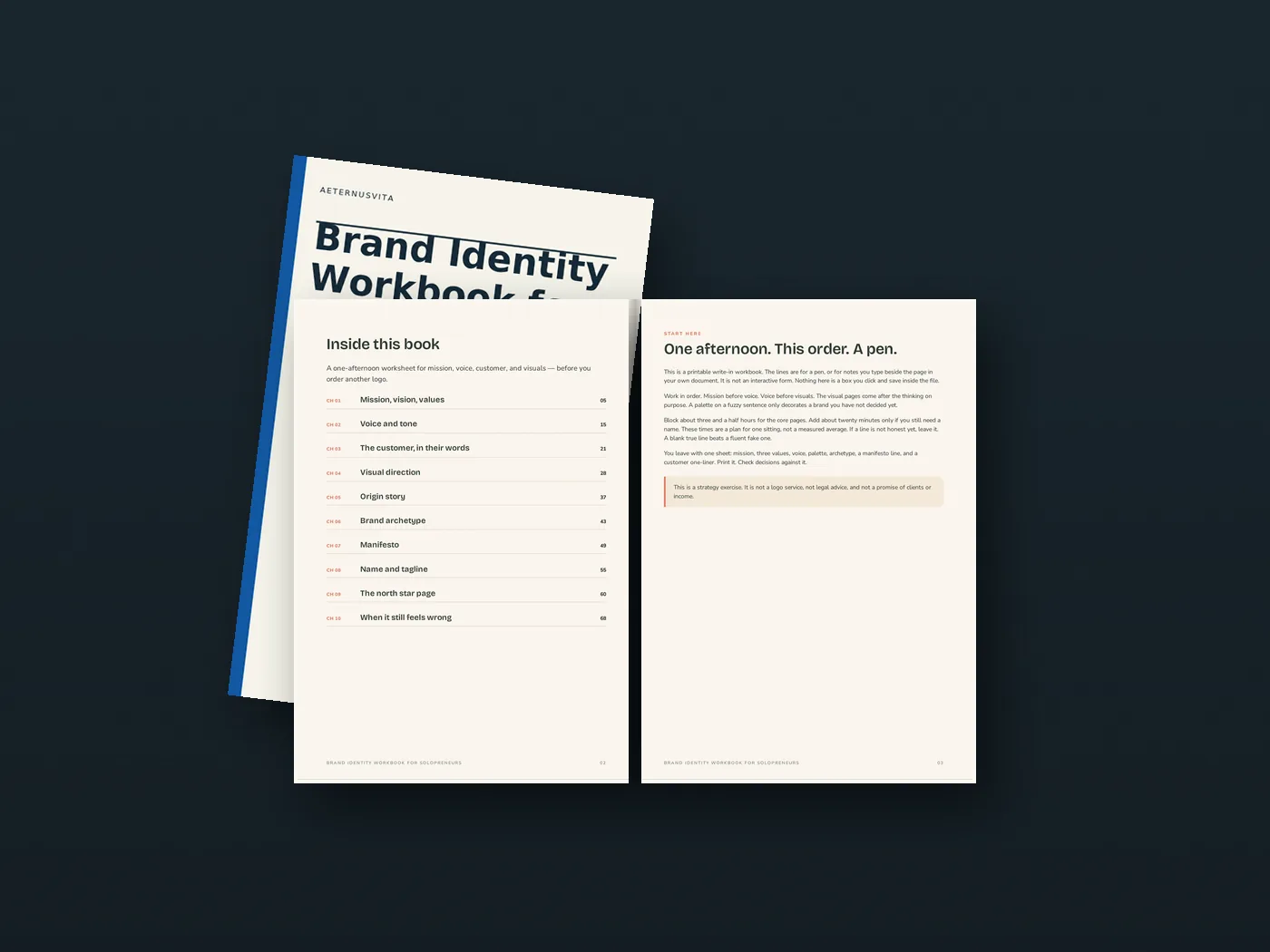
Ten sections across 71 pages. You move from the mission sentence to the north star sheet, with six repair tests and a four-Friday check after it. The download includes one combined book PDF (guide and workbook in a single file).
How to use it+
Print the pages, or type notes beside them in your own document. Block about three and a half hours and work in order. Pin the sheet, and use the five questions before anything goes out. Leave a line blank until you can stand by it.
Delivery and refunds+
Download after payment: a ZIP with the PDF, a README and the licence. Refunds follow the policy shown at checkout.
Made for the afternoon you almost order a logo
You are about to brief a designer
The last mark looked fine, and the captions still wander. Leave the next logo until the north star sheet exists.
Your posts do not sound like one person
A pep talk, then a joke, then a brochure. You read recent posts aloud and write a sentence at each of five voice marks.
The offer is real and the brand is still a mood
You work alone as a freelancer or a coach. The pages ask for one customer situation and three values you would pay to keep.
The problem
The logo arrives before the sentence
A handsome mark can still send you back to redo the site a few months later. That happens when the brief never said who the work was for. You write that brief on paper first. The palette is a later chapter.
How it works
One order of work, then one sheet
Mission, vision and values come first, then voice and the customer. Visual direction follows, because a palette on a fuzzy sentence only decorates a brand you have not decided. Origin, archetype and manifesto come after that. Open the name pages only if you still need a name. Allow about three and a half hours for the core. The book calls that a schedule for one sitting. Copy what you reached onto one sheet of seven fields. Leave a line blank until you can stand by it.
This workbook vs generic brand advice
The sentence has to exist before the palette
If mission, voice or the customer page is still blank, the visual chapter sends you back. A pile of pictures cannot invent those lines.
Each slider runs from 1 to 7. You prove the mark with a sentence you might send. Then you rewrite the same news at the other end and keep that version as a fence.
The handover is the sheet, the voice samples, the type pairing, the mood-board sentence and the origin draft. A designer can make the mark from that brief. You can do the same if you are the one opening the template.
Voice and tone01
Five sliders, then a sentence you would send
Five sliders: formal to casual, serious to playful, reserved to bold, corporate to personal, and minimal to expressive. Mark 1 to 7 on each and write a sentence you might send at that point. Voice stays put. Tone can flex, and it should still sound like the same person. A collaborator should be able to match your samples from the page.
Visual direction02
Colour jobs, small type, then the pictures
Choose one primary, at most two secondary colours, and one accent. Name the job, and write where that colour must not appear. Make three type pairings and judge the body text at about 10pt on a phone. Collect 15 to 20 images and write one line for the pattern: mostly this, almost never that. You leave with a direction a designer can carry out.

When it feels wrong03
Six tests before another logo
The last section names six stuck points: mission, values, sliders, customer, colours, or another logo. Each point has one test. Run that test and leave the other pages alone. Four Friday rows afterwards record one thing you sent, and whether it still matches the sheet. Sales sit outside that check.
Set the desk, write in order, pin the sheet
One sitting. A pen, or a document you will reopen.
 1
Step 1
Put this on the desk
A pen, recent posts or proposals, any phrases buyers have used, and a phone for the small-type test. Leave the next logo until the sheet exists.
 2
Step 2
Work the sections in order
Mission through manifesto, with visuals after the customer. Name and tagline only if you are still deciding. Leave a line blank until you can stand by it.
3Step 3
Print the seven fields
Mission, three values, voice, palette, archetype, a manifesto line, and a customer one-liner. Pin the sheet where you write, and check the next piece against it.
Timeline
What to expect
Solo businesses differ. Here is how the workbook is designed to be used.
Do the sitting
Allow about three and a half hours and work in order. Add about twenty minutes only if you still need a name. The pages are laid out so you end on the seven-field sheet. A line can stay blank until you can stand by it. Those times are a schedule for one sitting. They are not a measured average.
What's inside
- Chapter 1. Mission, vision, and three values that each name a cost
- Chapter 2. Five voice sliders, sample sentences, and an opposite-voice drill
- Chapter 3. Four customer questions, an echo line, and one person you will not serve this year
- Chapter 4. Palette by job, three type pairings at about 10pt, and 15 to 20 images
- Chapter 5. Origin story in three acts, under 200 words, then shorter cuts
- Chapter 6. Twelve archetype names as tone tools. You pick a primary and a secondary, and the book gives no point total.
- Chapter 7. A first-person manifesto, kept as source material for single lines
- Chapter 8. Keep a name people already use, or three prompts and a tagline under eight words
- Chapter 9. Seven fields on one sheet, an invented example, and how to brief a designer
- Chapter 10. Six repair tests, then four Fridays that record use. Sales stay off the tracker.
Preview the pages
Still have questions?
Is this a logo design service?+
No. You write a visual direction. The mark comes later, from you or from someone you brief with the sheet. On names, you check whether you may use one in your own country. The book does not give legal advice.
How long should I allow?+
About three and a half hours for the core pages, plus about twenty minutes if you still need a name. The book treats those minutes as a plan for one sitting, not a measured average. Stop a section when the line is honest, even if the clock has time left.
Can I fill it in on a tablet?+
The pages are a printable write-in for a pen, or for notes you type beside the page in your own document. Nothing on the page is a box you click and save inside the file.
What if I already have a name and a logo?+
If people already use the name and it matches the mission, the name chapter tells you to keep it. Boredom with the sound is not a brief for a new one. Repair a fuzzy sentence before you order another mark.
Will this bring me clients or a higher fee?+
No. The sheet is a filter for captions, briefs and the next rebrand question. What happens next depends on your market, your offer, and the work you do after the sitting.
Is the sample brand in the book a real client?+
No. North Ledger is invented to show the shape of a finished sheet. It is not a client and not a result. Use your own sentences on your sheet.
How do I get the files?+
You get a download after payment: a ZIP with one combined book PDF, a README and the licence. The workbook is 71 pages. Refunds follow the policy shown at checkout.
Instant PDF download · 71 pages · Print and write in
Educational only. A strategy exercise, not a logo design service, not legal advice on names or trade marks, and not financial, tax or business advice. Nothing here promises clients, income, or a brand that never needs a revision. Written with AI assistance, reviewed by AeternusVita.
Brand Identity Workbook for Solopreneurs