1 / 5
- 150 numbered prompts
- You send the words
- Solicitor signpost
- Paste into any chat
Desk guide · 150 prompts
150 prompts that will not invent the wedding
This desk guide is for solo and boutique planners and for day-of coordinators who already have clients. The prompts run from the first enquiry to the wedding day. Where a fact is missing, type Not given, then send the email yourself.
- P001 to P150, with the 30 captions counted inside that total
- A voice worksheet, because a prompt without your phrases sounds like a brochure
- Worked examples written for this book, using fictional couples
- An eight-row supplier chase log and a wedding-day fire card
AI Prompts for Wedding Planners
£15
- +One combined book PDF (guide and workbook in a single file)
- +ZIP with the PDF, a README and the licence
One-off payment. Download starts after checkout.
30-day refund. If it isn't useful, reply to your receipt within 30 days for a full refund.
Instant PDF Print or tablet Any device
What it is+
A desk guide for wedding planners and day-of coordinators who write the same kinds of emails each season. The prompts are for a chat assistant. You paste the facts you have, and you still send the words.
What's inside+
Eleven chapters, from the voice block and the privacy rules through to the wedding-day fire card. Prompt numbers run P001 to P150. The guide and workbook are in one combined PDF.
How to use it+
Read the decision note at the start of the chapter and choose the number yourself. Paste your voice block and fill every bracket. Type Not given where your notes are silent. Read the CHECK lines and add one sentence from the real conversation. Send from your own mailbox.
Delivery and refunds+
Instant download after payment. You receive the guide PDF and the workbook PDF inside a ZIP that also holds a README and the licence. The page count is 103. Refunds follow the policy shown at checkout.
Made for planners who already have the work
You run the planning business
You are a solo or boutique planner with clients and suppliers already on the books. What stalls is starting from a blank email.
You coordinate on the day
You write timings and supplier chases all season. After a call, you still owe the couple a recap they can correct.
You have to turn work away
An enquiry sometimes sits outside what you take. P012 is a decline under 120 words, using a reason you supply. A referral goes in only when you already have a name.
The problem
A smooth draft can still be a guess
The enquiry reply or the supplier chase will not start, so you paste a few lines into a chat. What comes back is smooth, and it may name a flower nobody chose or a fee you never typed. The book names that failure. Empty facts in, invented wedding out. Chapter 1 also lists what stays out of the chat, starting with card numbers and guest home addresses.
How it works
Pick the number, then fill your facts
Each chapter opens with a decision note, and you choose the prompt. P004 is the follow-up when an enquiry is thin. P018 is a single chase, and you type the interval. The chapter does not treat three days as a rule. Paste the voice block from the chapter 1 worksheet and fill the brackets. Printed times beside those moves run from about a minute to a few minutes. The book says a specific brief is faster to edit than a vague one. It also says it does not measure that for you.
This book vs generic advice
150 means 150, and you still sign it
The captions are P065 to P094, so the thirty photo lines sit inside the 150. The book prints the addition 14+14+14+12+10+30+12+14+10+10+10. If a page disagrees with that sum, the book says the page is wrong.
Every prompt inherits the standing brief. The draft may use only facts you pasted, in UK English, and it must end with a CHECK. That CHECK names the facts used and the facts refused. It also flags any sentence you should rewrite if it carries feeling, money or risk.
The last move is one sentence only you could write, sent from your own mailbox. The book says a draft is a head start, and that the couple hired you for the judgement after it.
Client intake01
From the enquiry to a recap
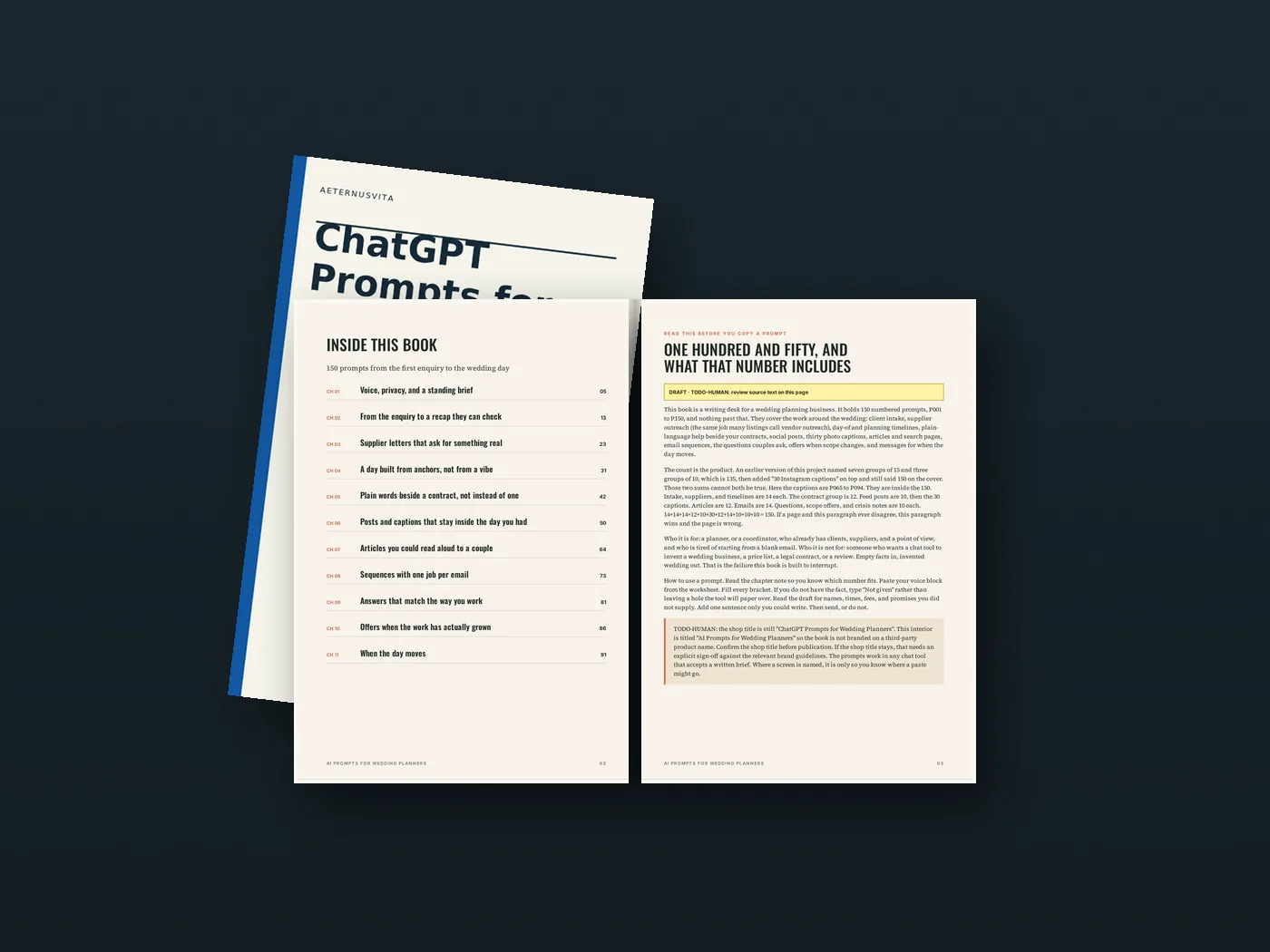
P001 to P014 stay inside notes you already have. P001 to P003 produce a summary, the gaps before a call, and a 30-minute agenda. A thin enquiry gets one short email. Silence gets one further note, and then you stop. After the call, P014 is the recap the couple can correct. P012 is a decline under 120 words when the work sits outside what you take. The worked example is fictional, and Amira and Jonah are the couple on the page. In the sample, a missing fact stays missing.
Posts and captions02
Thirty captions, inside the 150
Feed posts run P055 to P064. The thirty captions are P065 to P094, counted in the same 150. A public line leaves out the couple, a guest and a child. Names stay in only when you paste that permission was granted. Two lengths are specified, under 25 words and under 70. Hashtags stay out unless you pasted a list. A caption may praise only a detail you pasted. One worked example writes a single photo both ways.
When the day moves03
Ten prompts for a day that changes
P141 to P150 are for a day that is no longer the plan you sent. The ten prompts cover rain, a delay, a no-show, privacy and the log you keep. A fire card and a phrase worksheet sit with them. Fill both before the season, from decisions you have already made. The quick card says to hold a draft that states a legal right or admits fault. It also says to hold a promise of a refund, a date or a supplier you have not confirmed.
Run one prompt
The same order, whichever number you choose.
 1
Step 1
Choose the number
Use the decision note in that chapter. You already know which job this email does.
2Step 2
Fill every bracket
Paste the voice block from your worksheet. If a slot has no fact behind it, type Not given. A blank slot is how a guest count you never wrote ends up in the email.
3Step 3
Check, then send
Read the CHECK lines for a fee, a time or a name you do not recognise. Delete that draft and run it again with the gap filled as Not given. Add one sentence from the real conversation, and send from your own mailbox.
Timeline
How the book is meant to be used
Seasons differ. The stages below follow the desk pages. The book does not measure how long a draft takes you.
Write the voice block
Fill the tone worksheet. Include five adjectives, three phrases you use, three you refuse, and your sign-off. Save the standing instructions in the chat tool you use. If that tool has nowhere to save them, paste the brief at the top of a new chat.
What's inside
- Chapter 1. Voice, privacy, the list of what you never paste, and the standing brief
- Chapter 2. Client intake, P001 to P014, with a couple brief to fill first
- Chapter 3. Supplier outreach, P015 to P028, plus an eight-row chase log. Many listings call these vendor emails.
- Chapter 4. Timelines, P029 to P042, plus allowances the book says are not survey results
- Chapter 5. Contracts in plain words, P043 to P054, with a solicitor signpost
- Chapter 6. Social posts and captions, P055 to P094, ten posts and thirty captions
- Chapter 7. Search articles, P095 to P106, outlines and page copy you can stand behind
- Chapter 8. Email sequences P107 to P120 cover nurture, welcome, week-of, thank-you and review. Consent to email is in the chapter.
- Chapter 9. Questions couples ask, P121 to P130, from your own policies and your own fees
- Chapter 10. Adding scope, P131 to P140, including a clean no. The offers are ones you already sell.
- Chapter 11. When the day moves, P141 to P150, with the wedding-day fire card
- Desk pages: a six-week writing plan, a prompt quality log, a season checklist and a page on bad drafts
- One combined book PDF (guide and workbook in a single file)
Preview the pages
Still have questions?
Is this legal advice?+
No. Contract prompts ask questions and restate clauses you paste, in plain words, for a solicitor to check. The standing brief tells the assistant not to state anyone's rights. A fluent paragraph is not a green light to send.
Does it only work in ChatGPT?+
The prompts are written briefs. The book says they work in any chat tool that accepts one. It does not name a plan or a setting, because those change. The standing brief asks for UK English: enquiry, supplier, wedding breakfast and evening reception.
Are the worked examples real weddings?+
They are illustrations written for the book. The couples are fictional. Nothing in them is a captured chat or a client result.
What if I do not have the fact?+
Type Not given in the empty slot. A blank is an invitation to invent a guest count. When the notes are almost empty, use P004 or P012. P001 is the wrong prompt for a form with nothing in it.
Will it tell me what to charge?+
Your fees have to be in the notes you paste. The budget prompt asks questions. The proposal prompt is a cover email for a sheet you have already written. It does not add a discount.
Who should skip this?+
It is for a planner or coordinator who already has clients and a point of view. Prices and contracts have to come from you, and so does any review. The book is the wrong desk if you want the chat to invent the business.
What do I download?+
Payment is followed by an instant download. You get one combined book PDF (guide and workbook in a single file). The ZIP also holds a README and the licence. Count on 103 pages, set out as A4 desk pages. You can read the PDF on screen, or print a quick card if you want it beside the keyboard.
Instant PDF download · 103 pages · Guide and workbook
Educational only. This book is not legal advice. Contract prompts are questions and plain-language restatements for a solicitor to check. Written with AI assistance, reviewed by AeternusVita.
AI Prompts for Wedding Planners